
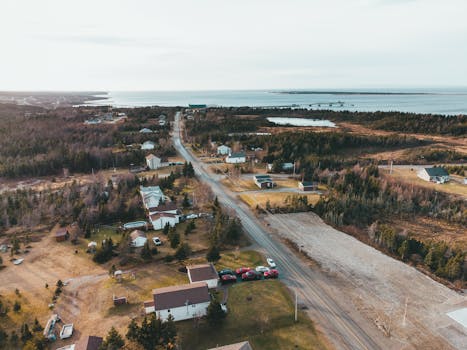

Remember the days when a power outage meant truly disconnecting? No flickering screens, no endless scrolling. Just candles, board games, and perhaps a spontaneous neighborhood gathering. In our hyper-connected world, this feels like a distant memory, especially as we witness a quiet trend: less connectivity in the suburbs and rural neighborhoods. It’s not always about a lack of infrastructure, but sometimes a deliberate choice, or perhaps a consequence of focusing on different priorities. This shift prompts an intriguing question: what if this perceived deficit is actually an untapped asset?
It’s easy to assume that lower bandwidth or fewer smart devices automatically equates to a diminished quality of life. But as I’ve explored this topic, I’ve been struck by the quiet resilience and unique advantages found in these less digitally saturated spaces. It challenges our modern definition of progress and invites us to consider what truly enriches our lives.
Beyond the Bandwidth: What “Less Connectivity” Really Means
When we talk about “less connectivity in the suburbs and rural neighborhoods,” it’s rarely a complete digital blackout. More often, it’s a spectrum. This can manifest as:
Slower, less reliable internet speeds: This is perhaps the most common association. It’s the difference between instant streaming and buffering, or the frustration of a dropped video call.
Limited access to the latest smart home technology: While urban dwellers might have voice-activated everything, rural homes may rely on simpler, more manual systems.
Fewer public Wi-Fi hotspots: The ubiquity of free Wi-Fi in cafes and libraries in cities is often a rarity in more spread-out communities.
A reduced cultural emphasis on constant digital engagement: In some of these areas, there’s simply less societal pressure to be online 24/7.
It’s not necessarily about being cut off, but rather about a different relationship with technology. One where it serves a purpose without overwhelming every moment.
The Unexpected Gifts of Digital Space
This deliberate or circumstantial reduction in constant digital immersion can unlock a surprising array of benefits. It’s about reclaiming time, fostering deeper connections, and rediscovering the simple pleasures often drowned out by the digital noise.
#### Cultivating Deeper Human Connections
When screens aren’t constantly demanding our attention, our eyes naturally turn to the people around us. I’ve often found that in areas with less pervasive connectivity, neighbors are more likely to know each other, wave hello, and genuinely engage in conversation.
Face-to-face interactions: Without the ease of digital communication, there’s a greater impetus to meet up, chat over the fence, or plan community events.
Stronger family bonds: Mealtimes can become true family time, free from the distraction of notifications. Storytelling and shared activities take center stage.
Community cohesion: Shared experiences, often facilitated by local events rather than online groups, can foster a powerful sense of belonging.
This isn’t to say urban areas lack these connections, but the default setting in less connected environments often encourages them more readily.
#### Reclaiming Your Time and Attention
Our devices are designed to capture and hold our attention. The less these devices dominate, the more time and mental energy we have for other pursuits. This is a crucial aspect of understanding the advantages of less connectivity in the suburbs and rural neighborhoods.
Reduced digital fatigue: The constant barrage of emails, social media updates, and news alerts can be exhausting. Less connectivity offers a respite.
Increased focus and productivity: Without the constant temptation of online distractions, it becomes easier to concentrate on tasks, hobbies, or simply being present.
More time for offline activities: Reading a physical book, tending a garden, exploring nature, or pursuing creative endeavors can flourish when digital demands are lower.
Think about how much time is spent simply scrolling. Imagine redirecting that time towards something that truly nourishes you.
Navigating the Digital Divide: Strategies for Thriving
While the benefits are compelling, acknowledging the challenges is essential. How can those living with less connectivity ensure they aren’t left behind in an increasingly digital world? It’s about smart adaptation, not necessarily full immersion.
#### Strategic Connectivity: Making Every Bit Count
It’s not about having the fastest connection, but the right connection for your needs. For those in areas with limited options, this often means being more intentional.
Prioritize essential services: Ensure you have reliable access for critical tasks like online banking, healthcare appointments, or communication with family.
Utilize offline capabilities: Download movies, music, and podcasts when you have access to better bandwidth. Many apps offer robust offline modes.
Explore alternative access points: Are there community centers, libraries, or local businesses that offer Wi-Fi you can use for specific needs?
Understanding the available infrastructure and planning around it is key.
#### Embracing the “Slow Tech” Lifestyle
This isn’t about rejecting technology, but about curating it. It’s a philosophy that values intentionality and mindful use.
Choose devices wisely: Do you really need the latest, most connected gadget, or would a simpler, more durable option suffice?
Set boundaries: Designate tech-free times and zones in your home.
Focus on utility, not novelty: Does a smart device genuinely improve your life, or is it just a trendy addition?
This approach allows you to harness the power of technology without being enslaved by it, a particularly valuable skill when facing less connectivity in the suburbs and rural neighborhoods.
The Future of Connectivity: A Spectrum of Choices
Perhaps the narrative around connectivity needs a reframe. Instead of viewing it as a binary of “connected” or “disconnected,” we should embrace a spectrum of choices. The experience of less connectivity in the suburbs and rural neighborhoods isn’t a deficiency; it’s a different way of living that can offer profound advantages. It’s a reminder that true richness often lies not in the sheer volume of data we consume, but in the quality of our human interactions and the depth of our experiences.
As technology continues to evolve, these less connected communities may even become havens for those seeking a more balanced and intentional life.
Final Thoughts: What’s Your Digital Ideal?
The quiet charm and intentional living often found in areas with less connectivity present a compelling alternative to our hyper-digital present. They highlight the enduring value of human connection and the reclaiming of our most precious resource: time and attention.
So, as you consider your own relationship with technology, ask yourself: what does your ideal level of connectivity look like, and how can you cultivate more of the richness you truly desire, whether you’re in a bustling city or a peaceful rural lane?


